My-CoMind Start free

The problem is not memory. It is the switching.

Mentoring one founder is easy to hold in your head. Following eight or ten is a different job. Each has a distinct arc — a pivot in March, a co-founder conversation you promised to revisit, a hiring decision that was still open last time. None of it is complicated on its own. What makes it hard is that you switch between them every few days, and each switch costs a reconstruction.

So the fifteen minutes before a session get spent skimming old notes, or the session opens with "remind me where we landed on..." — which puts the work of remembering onto the person you are meant to be helping.

Why the usual tools do not fix it

The common failure is the same in all three: they store what happened and leave you to reconstruct what it means. That gap has a name — cognitive continuity — and it is the actual problem.

What it looks like instead

1

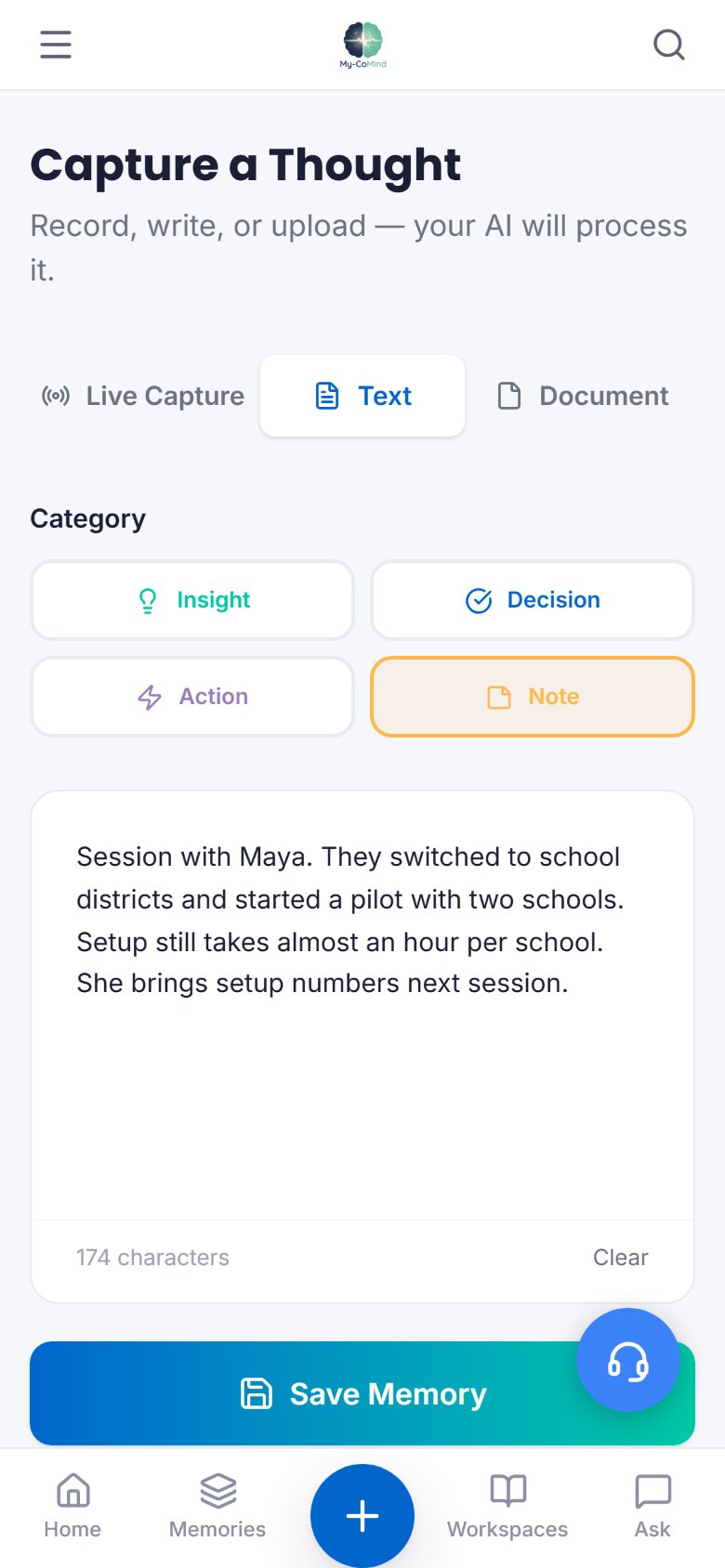
Record the session, or talk for two minutes after it

Live Capture runs during the call and picks up the conversation, including the other participants. If you would rather not record, dictate a couple of minutes afterwards — it works the same way. Documents and decks can be dropped in too.

2

It files itself against the right founder

Decisions, action items and open questions are pulled out automatically, and the session joins everything else about that person. No tagging, no folders, no naming convention to keep up.

3

Next time, open the workspace instead of your notes

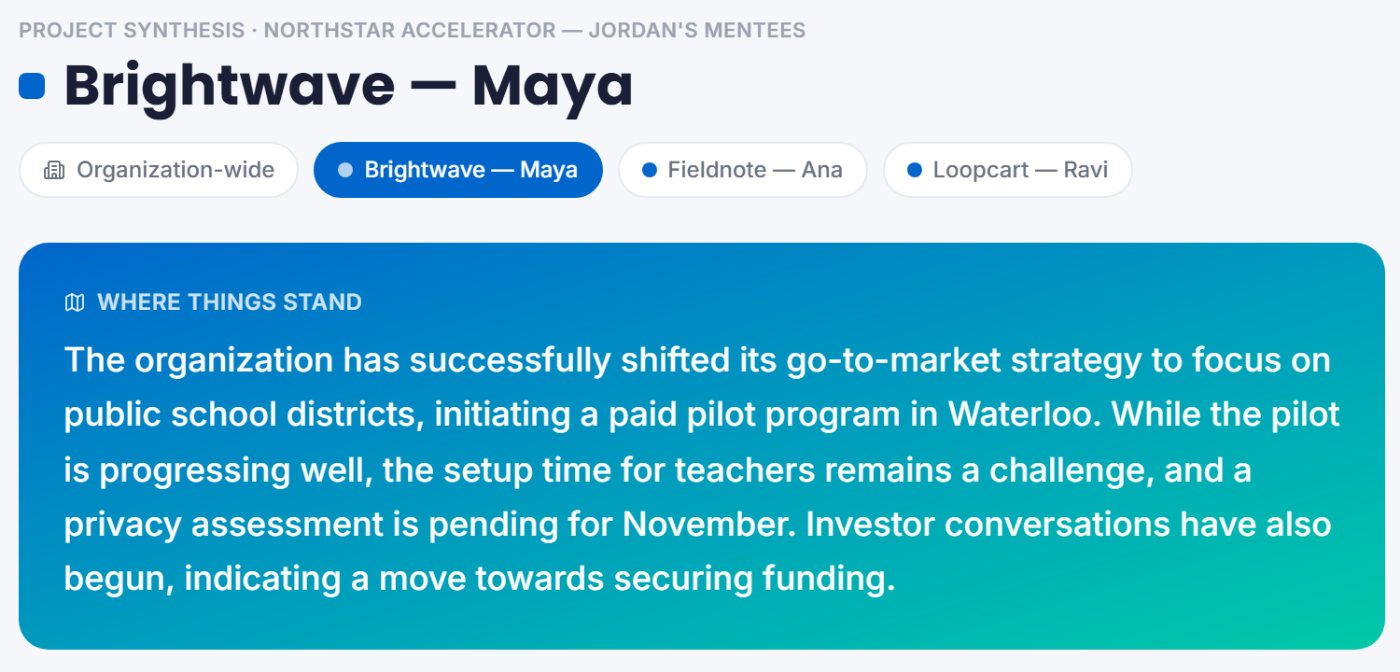
Where things stand today, the milestones that got them here, which decisions are in effect, which were superseded, and what is still unresolved. Ten seconds instead of fifteen minutes.

A living workspace for one mentee, showing current status, milestones and open points

One workspace per person you follow — current without being maintained

The part that only works when you follow several

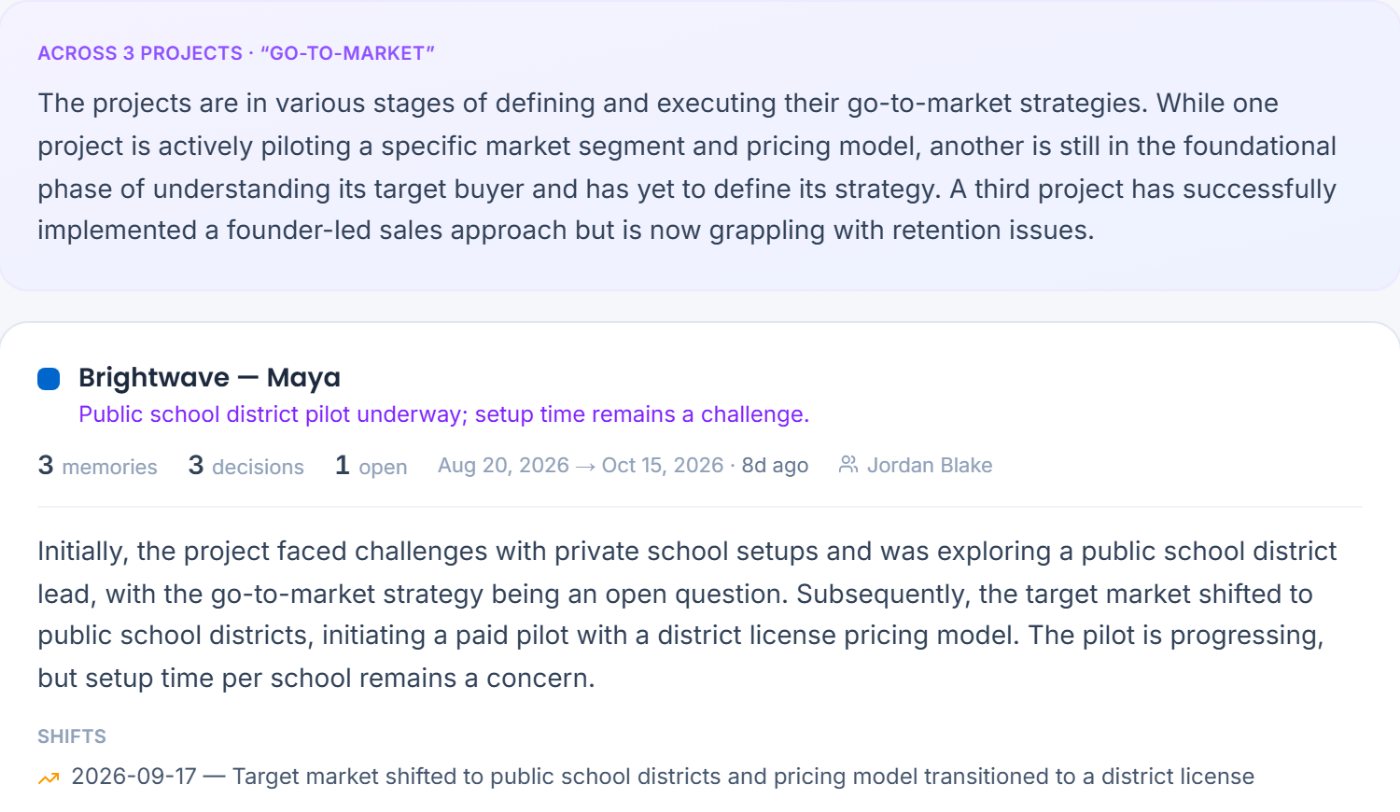
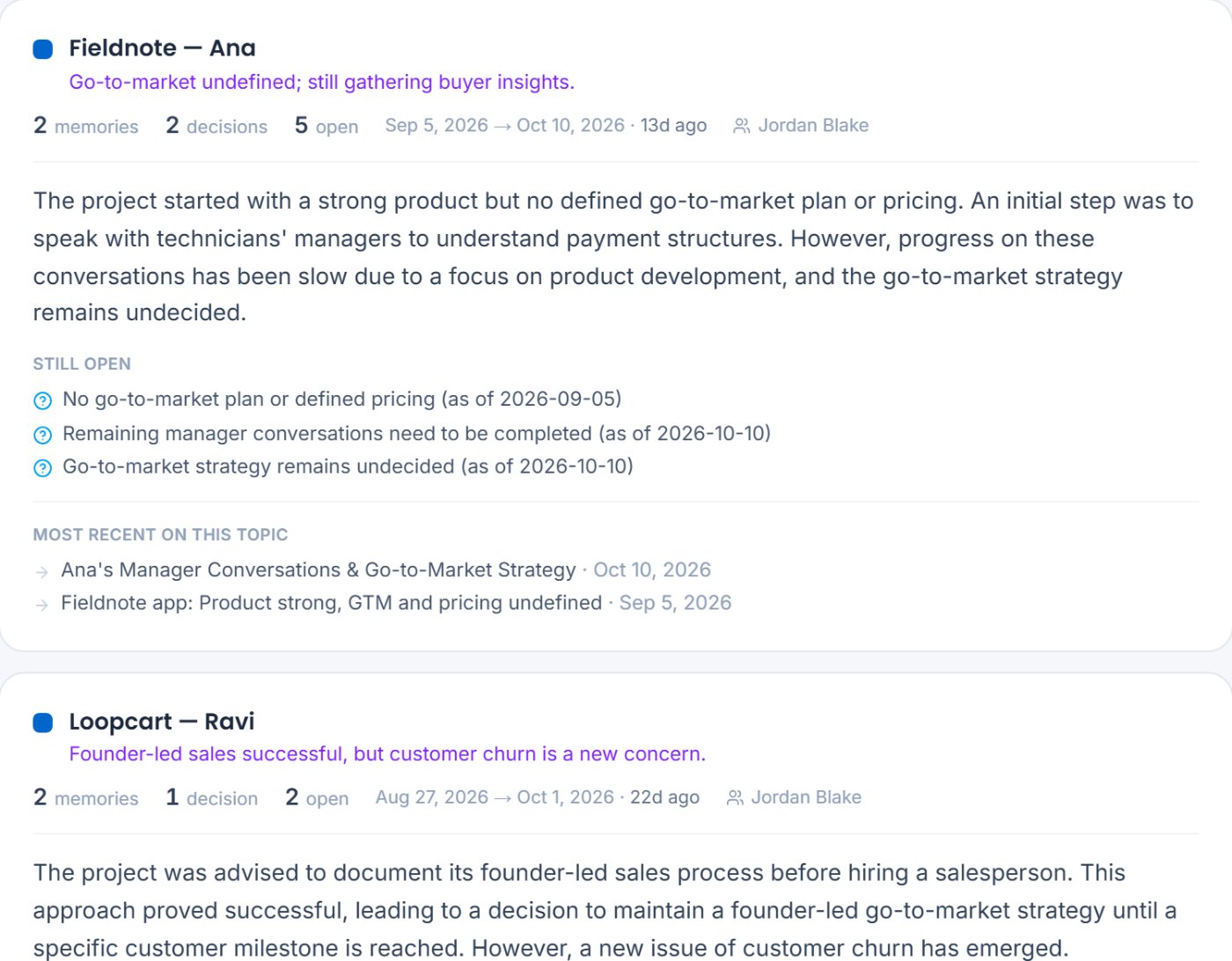
Once each founder has their own project, a single question can be asked across all of them at once. Search “go-to-market” and you get one reading per company: who shifted approach and when, who has not touched it in two months, what is still unresolved.

This is the view that does not exist anywhere else, because it requires the per-person context to already be structured. It is useful to you as a mentor, and it is the view a program director normally has to request as a status update from everyone.

Seeing a founder change direction

Because positions are kept with their dates rather than overwritten, a change of direction stays visible instead of silently replacing what came before. You can see that a founder held one view of their ICP for four months and now holds another — which is often the most useful thing to raise in the next session, and the easiest thing to miss when you only see the current state.

It is descriptive, never a score. Changing your mind is usually evidence of learning; the point is to notice it, not to grade it.

What your mentees tell you stays yours

Mentoring runs on candour, and candour depends on confidentiality. That constraint shaped how the product works rather than being added to it afterwards.

If you mentor through an accelerator, this is what lets you keep your own working context separate from what the program sees.

"My-CoMind has helped take my workflow to a new level. It lets me organize my clients, scale my operations, and deliver more relevant, actionable guidance — all without adding more work to my day."

VentureLab Mentor

Questions mentors ask

How do mentors keep context between sessions?
By capturing the session itself rather than writing notes about it. The recording becomes a memory that joins everything else about that mentee, and the workspace for that person stays current on its own — so the next session opens with where things stand, what was decided and what is still open.
Do I have to write session notes?
No. You record the conversation, or dictate a couple of minutes afterwards, and the decisions, action items and open questions are extracted automatically. There are no fields to fill in and no folders to file into.
Can I keep each mentee separate?
Yes. Each mentee or company gets its own project, and material only enters a project when you explicitly share it there. Your personal memory stays personal by default.
Is what my mentees tell me kept confidential?
Your memory is private by default and is never used to train AI models. Nothing is shared with an organization or another person unless you share it, and a shared memory can be withdrawn at any time. My-CoMind is operated by MY-COMIND INC. in Ontario, Canada, under PIPEDA and CASL. See the privacy policy.
Can I compare one topic across all the founders I follow?
Yes. Memory Continuity takes a single subject — go-to-market, hiring, pricing — and returns one reading per project, so you can see who moved on it, who stalled, and what is still unresolved across everyone you follow.
What if I already use a meeting recorder?
My-CoMind records natively with Live Capture and also imports transcripts from Fireflies. Imported material arrives as suggestions you approve before anything becomes a memory. See the full comparison with Fireflies.ai.

First, how much are you actually carrying?

Five questions on how many evolving contexts you hold, and how much of that history would survive if one relationship moved to someone else. There is a path for founders and for programs too.

Take the Context Load Audit → Nothing is stored.

Try it on your next session

Capture one conversation, then open it again before the following session. That is the whole test. Free plan, no credit card.

Start for free